What the Tap Does to the Bottle: A UK Water Map for Low-Alcohol Botanical Drinks
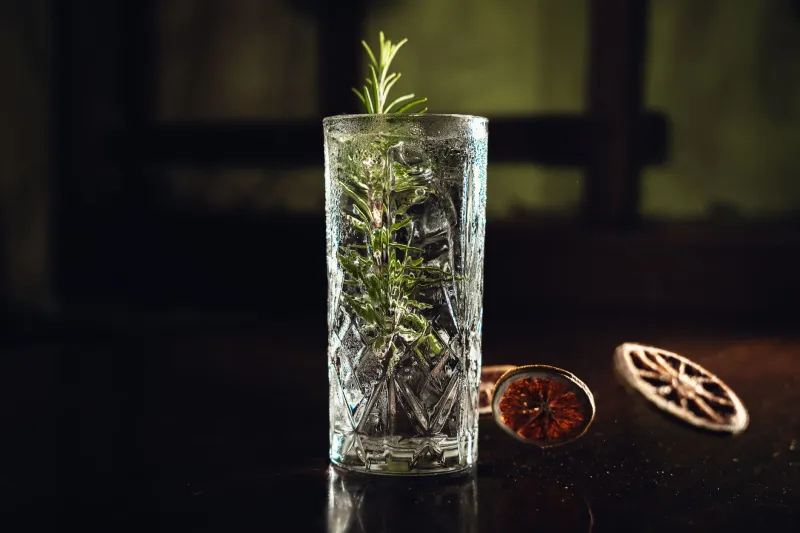
There's a particular kind of disappointment that comes from pouring a favourite low-alcohol botanical bottle at someone else's kitchen counter and finding it tastes… fine. Not wrong, exactly. Just quieter. Flatter. The grapefruit peel that usually zips through a 0.0% distillate sits there like it's been asked to wait in the hall.
Nine times out of ten the bottle hasn't changed. The water has.
First, what "hard" actually means
Hardness is shorthand for dissolved calcium and magnesium, normally quoted in milligrams per litre of calcium carbonate. Under about 60 mg/L and you're in soft territory. Two hundred and up is hard. Past 300 is properly crunchy — the sort of water that furs up a kettle in a fortnight and leaves a pale tide mark on a glass.
Two other characters matter just as much when you're building a drink. Bicarbonate buffers acidity, which is why hard-water tea tastes dull and scummy. And the balance between sulphate and chloride quietly steers bitterness and body: sulphate sharpens, chloride rounds.
None of it is exotic. It's geology with a postcode.
A rough map of the UK's taps
Soft (broadly under 80 mg/L): Leeds gets the bulk of its supply from Pennine reservoirs, so the water arriving in a Kirkstall kitchen is soft and low in minerals. Manchester is similar, fed from the Lake District and the Pennines. Glasgow's Loch Katrine supply is famously soft — barely 30 mg/L in places. Cardiff and much of south Wales run soft off the reservoirs. Birmingham is the quiet surprise: the Elan Valley aqueduct has been delivering soft Welsh water to the city since the Victorian era, so a Birmingham pour behaves nothing like a London one.
Hard (200 mg/L and up): London sits on chalk and gravels, and Thames Water's supply typically lands somewhere around 250–300 mg/L depending on the postcode — quite variable street to street. Norwich and much of Norfolk are extremely hard, drawn from the chalk. Bath and Bristol lean hard off Mendip limestone. Oxford, Portsmouth and large parts of Hampshire and Kent are all in the same boat.
Somewhere in the middle: Edinburgh, Sheffield, Nottingham, most of Devon and Cornwall — soft-ish to moderate, with pockets that flip either way.
Why it changes the drink
The clearest effect is on acidity. In a hard-water area, bicarbonate goes to work on the citric, malic and tartaric acids that give a low-alcohol aperitif its snap. The drink doesn't turn sweet — it turns vague. Citrus reads as a generalised fruitiness. Vermouth-style bitterness goes woolly. Some floral botanicals, elderflower especially, start to taste soapy around the edges.
Soft water does the opposite. Acids bite harder, tannins from things like bay, black tea or gentian feel grippier than they should, and a delicate pour can come across as thin and slightly sour. The upside is that fragile top notes — lemon verbena, rose, fresh basil — come through with real clarity.
There's a reason brewers in Burton upon Trent built their reputation on pale ale: the local water is heavy with gypsum, which is calcium sulphate, and sulphate pushes bitterness forward. London brewers worked with the opposite problem for centuries. That historical tug-of-war is basically the same thing happening in your glass, just with less fanfare.
Ice is a water decision too
A lot of the water in your drink isn't in the bottle — it's in the glass, melting. Hard-water ice tends to be cloudy and leaves a faint mineral film; more importantly, its meltwater carries the same buffering minerals straight into your pour as it dilutes. In London that means a long, slow melt can flatten a drink over twenty minutes. In Glasgow the same drink gets sharper as it sits.
Freezing doesn't remove anything, by the way. It just concentrates whatever was already there.
If your tap is hard
- Filter it, but know what a jug filter does. Ion-exchange cartridges swap calcium and magnesium for sodium or potassium. That's genuinely useful for drinks, though it nudges the water slightly salty. Change the cartridge on schedule — a tired filter is worse than no filter.
- Keep a bottle of low-mineral water in the fridge for lengthening and for ice. Something in the 20–60 mg/L range does the job; own-brand Scottish or Welsh still water is usually the cheapest route.
- Add a squeeze of lemon or a drop of acid to lift a drink that's gone flat. A tiny pinch of salt — a couple of grains, not a shake — also restores definition.
- Use fewer, larger ice cubes. Less surface area, slower melt, less buffering mineral creeping in.
If your tap is soft
- A drop of saline solution (about 20% salt by weight, kept in a dropper) rounds off harsh acidity beautifully. One or two drops per glass. This is standard bartending kit and costs pennies.
- Don't over-chill. Soft water already exaggerates sharp edges; a drink at 2°C is mostly just cold. Serve at 6–8°C and the botanicals behave.
- Steep shorter. If you're infusing your own low-alcohol base, soft water pulls tannins out fast. Knock a third off your usual time for anything with bark, root or leaf in it.
- Consider a mineral-rich mixer. A tonic or soda with a decent mineral profile will do some of the rounding for you.
Don't forget the chlorine
London and a growing number of UK suppliers now dose with chloramine rather than chlorine, and chloramine doesn't gas off if you leave a jug on the counter overnight. It reads as a faint swimming-pool note in a delicate drink. A carbon filter jug handles it; so does a fridge jug with a carbon cartridge. In soft-water cities, chlorine is often the only off-flavour in an otherwise clean glass, so it's worth ruling out before you blame the bottle.
A two-glass test worth doing this week
Pour the same measure into two identical glasses, over the same number and size of ice cubes. Top one with tap water, the other with filtered or low-mineral bottled water. Taste both at two minutes and again at eight. The differences will tell you exactly which variable you're fighting — buffering, chlorine, or plain dilution.
Once you know, the adjustment takes seconds. A drop of saline in Glasgow, a squeeze of lemon in Norwich, a filter jug in the fridge in Leeds. The bottle was never the problem — it just needs the right water underneath it.