Bring a Bottle, Not a Lecture: Low-Alcohol Manners for the Host's Table
There is a particular moment at a dinner party, somewhere between the coats going on the spare bed and the first corkscrew appearing, when a guest hands over a bottle and the host does a small, polite tilt of the head. It says: lovely, thank you, what is it? If the bottle is a low-alcohol botanical, that tilt can mean any number of things. Curiosity. Mild panic. A quiet calculation about whether it needs to go in the fridge. Your job, as the guest holding the bag, is to make that moment easy.
Because the low-alcohol bottle has a reputation problem at the dinner table, and it isn't the liquid's fault. It's the commentary that often travels with it. The explanation of units, the comparison to a "real" drink, the slightly wounded look when nobody asks for a top-up. Bring the bottle. Leave the lecture at home.
The gift is the gift
Start with the simplest rule: a bottle you bring should be a bottle you'd happily drink on your own sofa, on a Tuesday, with no audience. If it's a bottle you've bought purely to make a point, it will taste like a point. Choose something you actually like — a dry botanical aperitif, a crisp low-alcohol sparkling, a gentian-forward something with a bit of grip — and hand it over as a gift, not a test.
This matters more than it sounds. Hosts have a mental map of their own table. They know what's in the oven, which glasses are clean, whether there's room in the fridge. A bottle that arrives with instructions attached becomes a small administrative task. A bottle that arrives with a shrug and a "thought this might be nice later, or not" becomes a pleasure. Give the host permission not to open it. Half the time they will anyway, out of curiosity and good manners, and it'll land better for being their idea.
Offer a pour, not a pitch
If the bottle does make it to the table, resist the urge to narrate it. You don't need to explain the alcohol content, the botanicals, the producer's philosophy, or the fact that it's "basically the same as gin minus the regret." Nobody at a dinner party wants a tasting note between the soup and the main.
What works is the ordinary language of generosity. "There's a bottle of that going round if anyone fancies a splash." That's it. Then pour one for yourself, in front of people, and enjoy it. If someone asks what it is, tell them briefly and warmly, and then ask them something else. The bottle earns its place by being good, not by being explained.
The one exception is the guest who is quietly not drinking — pregnant, driving, on medication, or simply taking a night off — and who has spent the first half of the evening being handed glasses of elderflower cordial with a sympathetic face. For them, a proper low-alcohol botanical is a small mercy. If you spot them, offer a decent pour without ceremony. Don't make it a moment. Just make it good.
Match the bottle to the table
A little forward planning pays off. Rich, slow-cooked things — a beef shin ragù, a mushroom and ale pie, a Sunday sort of stew — want a low-alcohol red or a dark, bitter botanical with some body. Fish, green things and anything with lemon want something crisp and dry, ideally with bubbles. A cheeseboard, which arrives late and lingers, wants a bitter aperitivo style: gentian, rhubarb, burnt orange, a bit of sweetness to meet the salt.
If you don't know the menu, bring something in the middle. A dry, herbal, gently bitter sparkling is the most socially flexible bottle in the low-alcohol aisle. It behaves like a aperitif, holds up with most mains, and doesn't collapse next to a pudding. It also looks generous in a glass, which is half the battle at a table where other people are on the wine.
The driver deserves a proper pour
Here is the thing that separates a thoughtful table from a merely polite one: what happens to the person not drinking alcohol. Too often they get a glass of something pale and apologetic, poured early and never revisited, while the wine goes round twice.
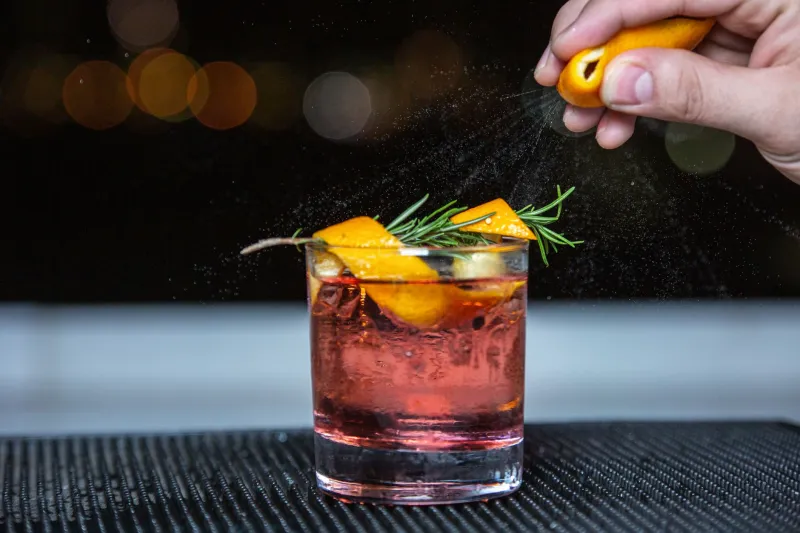
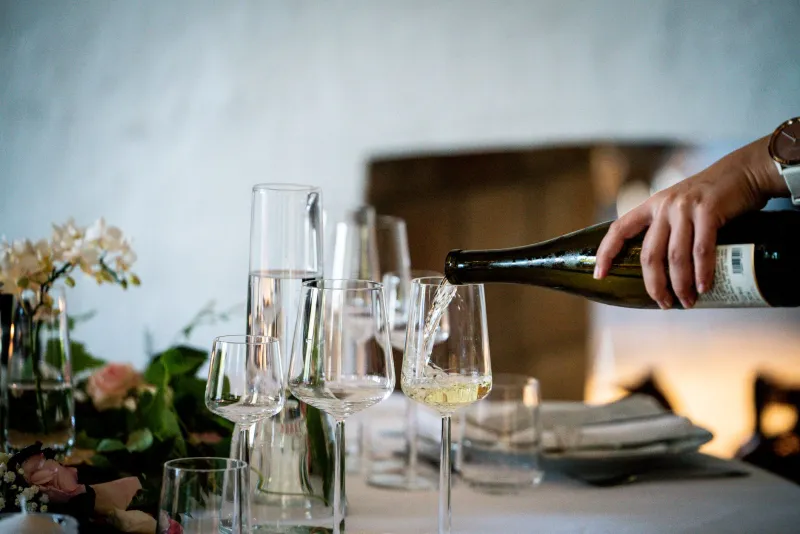
If you're the guest who brought the bottle, you can quietly fix this. Offer to pour it. Use a decent glass — the same one the wine drinkers have, not a tumbler from the back of the cupboard. Add ice if it wants ice, a twist of peel if there's peel going, a sprig of rosemary if the kitchen has one. Serve it at the same moment as the wine, not as an afterthought once the host remembers. Top it up when you top up your own.
None of this is complicated. It's just the difference between a drink that says "this is what you're having instead" and one that says "this is what we're having." The second is the whole point.
If the bottle stays in the bag
Sometimes the host won't open it. They've planned the drinks, the fridge is full, the table is set. That's fine. Let it go. A bottle left unopened isn't a rejection of your choices; it's just a Tuesday night with a lot going on. It'll get opened another time, or it won't, and either way the evening isn't about the bottle.
The considerate version of bringing a low-alcohol botanical to dinner is not about converting anyone. It's about turning up with something good, handing it over without a speech, and making sure the person who isn't drinking wine gets a glass that looks and tastes like it was meant for them. Do that, and the small tilt of the head at the door turns into something much better: a host who's genuinely pleased to see what's in the bag.